Food Waste-Based Compost: Benefits and Uses
A recent study by the University of Florida showed that compost made from food waste contains up to 3.5 times more nitrogen, phosphorus, and potassium (macro nutrients NPK) than compost made from yard waste alone, making it a much more nutrient-rich source of soil amendment.
Composting food waste also helps to reduce nutrient runoff into nearby waterways, making it an important part of any sustainable food system. What should you do with nutrient-rich food waste-based compost? Food waste-based compost is not ideal for use as a ground cover. Think of it more as a sustainably produced peat moss or as a "non-fertilizer" fertilizer alternative. Technically, it's a soil amendment that fosters plant and soil health by aiding nutrient and moisture retention.
If mixing a potting or bed mix
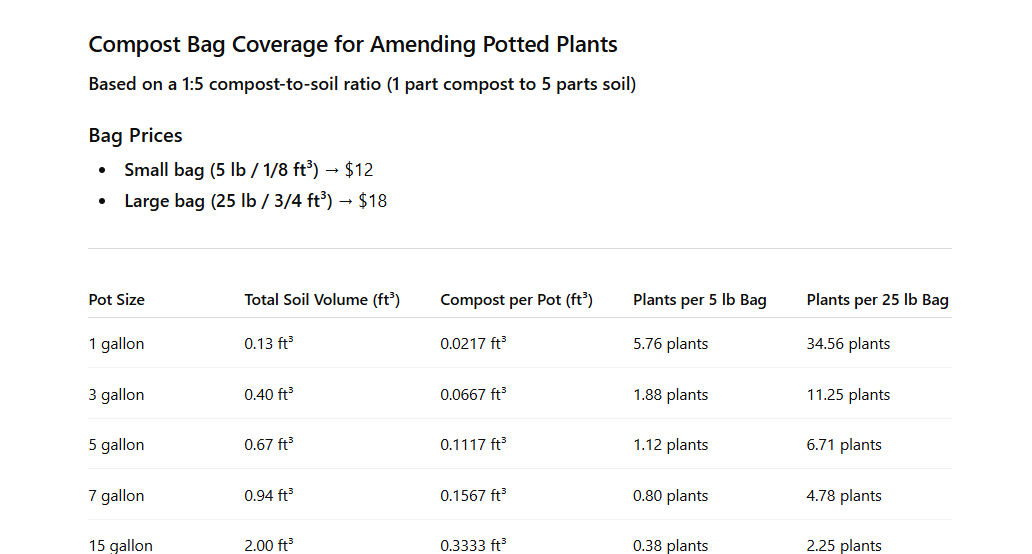
Mix 1 part food waste-based compost to 5 parts soil (i.e., 15%-20% compost) as a good baseline. Increase the ratio as desired. However, planting plants in a mix that is greater than 80%-85% compost to soil is not advisable because plants require elements from actual silicate dirt/soil beyond those that are available from compost. For this reason, retailers typically sell pre-blended soil mixes rather than pure compost.
If planting plants from the garden store
For smaller plants, using a one-pint plug or smaller, and adding 1/2 cup of food waste-based compost to the bottom of the planting hole typically yields the best results. When planting larger garden plants like trees or shrubs, a volume of compost equal to 30%-50% of the volume of the root ball should suffice. Add the compost to the bottom of the hole before planting, or work the compost into the top 2" of soil to simulate natural leaf litter.
If feeding an existing garden or bed
Topdress food waste-based compost directly around (but not directly on) the base of the plant stems you want to nourish. If mulching, add mulch between plants as ground cover after installing compost.
If preparing a new garden or bed
Apply either 0.25-0.5 pounds per square foot before tillage, or, for richer soil, add up to 4 gallons (~2.5 pounds) per square foot by volume.
If feeding a yard or agricultural land
The general rule of thumb is to apply a minimum of 5 tons per acre (0.25 pounds per square foot) when land applying food waste-based compost, and double that to establish an every-other-year regimen. Residual benefits occur the following year after a 5t/acer application or the third year following a 10t/acer application. However, establishing an annual or biennial routine will create the best results.